
Minimalism in the Serbian home
Or: how I retired my grandmother's tapestries

Crouching tapestry, hidden design
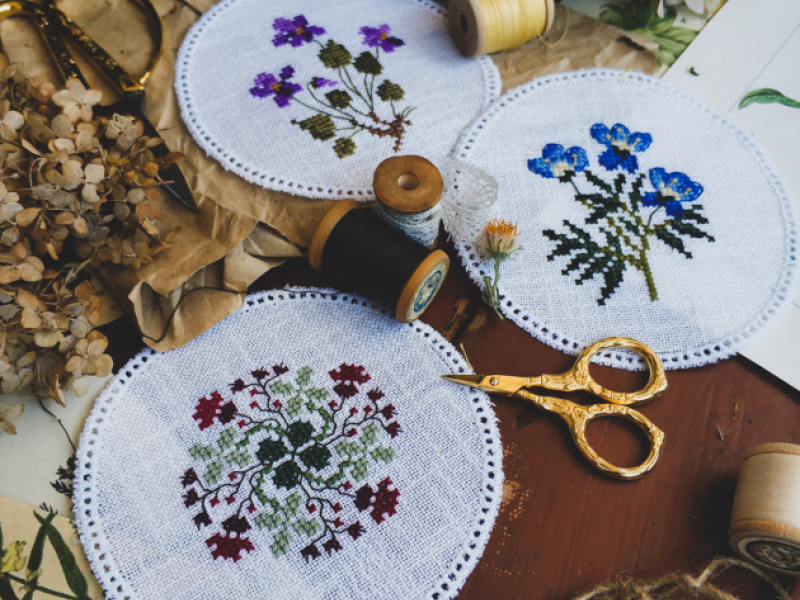
I grew up in a typical Serbian home, parents, a younger sister and an older brother with whom I shared a room. We painted the apartment once every couple of years, when we finally removed the wallpaper legacy of the seventies and eighties, my sister cried, and the central place in the hallway was occupied by the tapestry that mom brought "to marriage". Now, I never thought of it except as an antique that blended into the wall and whose removal would have provoked violent reactions from mom and even more violent reactions from grandma who embroidered it and tearfully gave it to her daughter.
And then that same beloved grandmother passed away. We were left with beautiful memories, a wonderful childhood spent in her yard, the memory of the warmth and the irreplaceable criticism about the noise (how is it that the neighbor's children are well behaved, and you squeal likelittle goats in full force?!). And her apartment.
Family gathered, and we decided to renovate, furnish and rent out the apartment. And that brings us back to the famous tapestry. In reality, I didn't even notice them, they had the power to merge with the walls and jump out to attack when you are forced to use grandma's landline. The renovation of her apartment required the artworks of her youth to be neatly put away, and only after removing all those curiosities (one was requested by a friend who placed it in her bathroom!), of which there were as many as 11 in the entire apartment, we were left with stamps on the walls and the idea of going from one overcrowded extreme to another - minimalism.
Minimalism in my home!?
(dealing with different)

Mom would like to decorate the apartment as if she would live in it, Dad is a miser (but after discussing the design he began to present himself as a committed minimalist), and we reason that minimalism is the simplest, most elegant, and as our "committed minimalist" said, the most cost-effective solution. Minimalism has certainly been a global trend for some time. It is based on simplicity and functionality (easy, right?), which we achieve through:
- Open space - open space, width and simplicity that is achieved by precise geometric solutions, straight and clean lines and transparency of the whole that we arrange. There is no exaggeration, overcrowding and ornaments that are there just to take up space.
- Functionality - avoiding redundant and unnecessary elements in the home, rejecting the idea that "everything must be kept" (whether for sentimental or other reasons), opening space to think carefully and weigh - which of the elements do we really need? What affects our daily life and makes it easier to carry out regular activities? If from the list of all the things we keep in the home, we eliminate those that do not get a single vote for staying, or those that are so rarely used that it is questionable to keep them, we are left with objects that are functional and necessary, and minimalism leads us to those questions. A true philosophy of life, isn't it?
- Colors and light – three colors, um, the same? Monochromatic aesthetics are characteristic of modern minimalism, and this applies both to walls, floors, and furniture. The minimalist ambience is airy, and it is dominated by white, but also natural shades of brown, beige and gray, and even black. In fact, minimalism is the realm of pastel! And other colors are welcome occasionally, but only to emphasize certain elements. Bright colors reflect light perfectly, and light is interestingly an excellent partner in designing and achieving the effect of width, comfort and spaciousness in a minimalistic space. Large windows, the best possible natural lighting and colors that additionally reflect and increase the effect of the lighting of the space have a great effect on the mood!
- Furniture - no more than necessary, and what is necessary is always simple, straight lines, smooth surfaces and practical. Built-in storage spaces (and we're not just talking about closets) will free up the space visually and still allow us to put away a few of those extra things that we can't get rid of while we get used to the minimalist aesthetic. Massive furniture is certainly not part of this story, the most important thing is functionality, and freeing the space from the superfluous, and in return the space will have a liberating effect on us (and who doesn't want to get rid of stress?). Minimalism does not deprive the space of decorations, but reduces them to a smaller number, and they remain in the line and color (with occasional highlighting of more intense colors) of the rest of the space.
And where is the soul?
(Final Judgment of the Ancestors)

Comfort and simplicity of choosing what pleases the person and suits the space.
Mom was not convinced that such an arrangement of space would have a soul, something that would make it a home (she was used to arranging only her own home, so she cannot switch to another point of view). Dad, a born-again minimalist in the conviction that all this "will cost nothing", still had to be born again when it was decided to choose quality, because we will not be renovating every year. And the final result is as follows:
- Mom is convinced that grandma's small apartment has more space than our four-bedroom (thank you for the light and monochrome!)
- Dad has already settled in to watch the game, and demands that we all wear slippers when we walk on the new floor (proud as if he installed it himself)
- Brother and sister nod and everyone is already choosing their palette for some future apartments
And I think that we ourselves bring the soul into the home. When it is unburdened, reduced and functional like this, and the light greets it from all sides, I feel that we have succeeded. Would grandma like it? I do not know. But I know that she was proud that one of her tapestries was comfortably passed on to the next generation to honor it in their own way.
(from the pen of a young agent, and perhaps also an interior designer)